skelsey
Members
-
Joined
-
Last visited
Everything posted by skelsey
-
 In this second part of our series on instrument flying (with apologies for the long delay from the first article!), we’ll be looking at how to fly some basic manoeuvres using both the full and the limited panel. Straight and Level To fly straight and level we need five elements: Constant altitude Constant airspeed Constant direction Wings level Aircraft in balance In visual conditions we identify each of these elements using outside references -- the position of the outside horizon in relation to the nose cowling, the distance of the wingtips from the horizon line and so on -- whilst the instruments can be consulted to confirm accurate flight. With the outside view obscured, however, we must replace those external references with information gathered from the instruments. Once again our control instruments are the attitude indicator and the power gauges. Just as in visual flight, we set the power required with reference to the engine gauges -- RPM, manifold pressure or EPR/N1. The flight controls are used to ensure the wings are level and the appropriate pitch attitude is set -- only this time with reference to the attitude indicator rather than the outside horizon. The performance instruments allow us to monitor whether we are maintaining straight and level accurately and can be divided in to two groups - those giving information about the vertical performance of the aeroplane (the altimeter, VSI and ASI) and those giving information about the horizontal performance of the aeroplane (the HSI, turn co-ordinator and balance ball). The altimeter directly indicates height. The VSI tells us about any trend away from that height. The ASI, meanwhile, indicates airspeed but indirectly provides information about height and pitch attitude - for instance, an increasing airspeed with a constant power setting implies a lower pitch attitude and, potentially, a loss of height. As for the horizontal performance, the HSI, clearly, provides a direct indication of magnetic heading. However, indirectly it also tells us about our bank angle (because if the heading is changing the wings are almost certainly banked) and rate of turn (by comparing the change in heading with the time taken). The turn co-ordinator directly indicates rate of turn, and in combination with the balance ball provides indirect clues about bank angle (because if there is no rate of turn and the balance ball is centred, it follows that the wings must be level). To maintain straight and level, we use exactly the same sequence as for visual flight -- P-A-T. Power is set to the cruising setting with reference to the power indicators Attitude is set to the level flight attitude using the elevator with reference to the attitude indicator Trim the aircraft to relieve any control forces required to maintain the selected attitude Straight and level flight is controlled by setting the correct pitch attitude on the ADI and the correct cruise power on the power gauges. Vertical performance is monitored using a selective radial scan of the altimeter, VSI and, to a lesser extent, the ASI. The altimeter is used to ensure that the correct height is being maintained. It will also indicate deviations from this altitude (and information about the rate of change of height can be gathered from the speed of movement of the altimeter needle). The VSI is very sensitive and will often register a rate of change of height before any significant movement of the altimeter. However, remember that both the VSI and the altimeter are subject to instrument lag and so great care must be taken to avoid overcorrecting and ‘chasing’ the indications back and forth. Small corrections for altitude deviations of less than 100 ft can be accomplished using pitch alone. The change in pitch attitude required is generally very small, in the order of only a single degree or so on the pitch ladder. Change the attitude slightly in the direction the correction is required Check the control pressure to hold the new attitude steady on the ADI Hold the new attitude and verify the correction is having the desired effect Trim to relieve the control pressure Deviations greater than 100ft will require a more positive correction and potentially an increase or decrease of power as well. However, even if the altitude is changing rapidly, the correction should still be smooth and progressive, with light pressure on the controls. The total pitch correction required, however, may still only be in the order of just one or two degrees. Instrument flying requires a light touch on the controls; this requires you to be relaxed and the aeroplane to be well-trimmed. Should you feel tense on the controls, one useful technique (provided the aeroplane is in trim) is to release all pressure on the elevator control for a moment or two and flex your fingers before replacing them on the controls. The thumb and first two fingers are more than sufficient for adequate control: a full hand grip may lead to lack of sensitive control and further tenseness. Limited Panel Whilst modern instruments are generally very reliable, there can be many reasons for them to fail or indicate incorrectly, a situation we are unfortunately well aware of from a number of aircraft accidents over recent years. Vacuum Failure One of the most common reasons for instrument failure in light aircraft is a failure of the vacuum system. This is because the gyroscopes which operate the artificial horizon and direction indicator are typically air-driven whilst the turn co-ordinator gyro is normally electrically-driven to provide redundancy. As such, most limited panel flying considers the failure of the artificial horizon and the gyro direction indicator, though other failures (for example, of the pitot-static system which would affect airspeed, altitude and vertical speed indications) are also possible (though, provided the artificial horizon is operating, relatively straightforward to deal with if the failure is correctly identified). Identification If an instrument failure is suspected, the inverted V scan can be used to determine the source of this issue. Here the artificial horizon, VSI and turn co-ordinator are scanned and their indications compared. These three instruments are typically driven by separate systems (the AH by a vacuum-driven gyro, the turn co-ordinator by an electric gyro and the VSI by the static system) so a failure of any one of the systems will result in that instrument displaying conflicting information. Inverted V scan One of the major challenges of dealing with instrument failure is disregarding the false indications of the failed instrument, which can be very distracting and enticing! For this reason it is not a bad idea to physically cover the failed instrument if possible, for example using a post-it note or similar. Straight and Level Without the artificial horizon, pitch and bank attitude information must be inferred through the use of the performance instruments. As we already know, provided the power is set correctly the altimeter, VSI and ASI provide a good guide to the aircraft’s pitch attitude: if the airspeed is increasing and the height on the altimeter reducing, the pitch is too low, and if the airspeed is increasing and the height on the altimeter increasing the pitch is too high. The ASI and altimeter can be used to infer information about pitch attitude Bank attitude can also be inferred using the turn co-ordinator and magnetic (‘wet’) compass. If the wings on the turn co-ordinator are level and the ball is centred, the aircraft’s heading is not changing and the wings must be level. This can be confirmed on the wet compass, which should also be unchanged. The turn co-ordinator be be used to infer information about bank angle. This is an example of an 'unusual attitude' - can you work out what corrections need to be made? Answer at the bottom of the article... Turns To make a turn on the limited panel, gently roll the wings using the ailerons in the direction of the desired turn, remembering to keep the ball centred with the rudder. As with all turns in instrument flight, the aim is to turn at Rate 1, so once the wings of the turn co-ordinator line up with the Rate 1 markings, neutralise the ailerons, use rudder to keep the ball centred and make small adjustments with the ailerons to maintain Rate 1, all the while keeping your scan of the altimeter, VSI and ASI going to maintain height. One of the advantages of flying a Rate 1 turn with a failure of the DI is that you can time the turn -- at three degrees per second a 180 degree turn will take one minute, a 90 degree turn 30 seconds and so on (allowing for time to roll in and out). So if you start a stopwatch as you roll in to the turn you will have a good idea of how long you will need to maintain the turn for. The wet compass is also used; remember however that the compass is subject to errors when turning through north or south. In the northern hemisphere, these can be easily remembered using the acronym UNOS: Undershoot North, Overshoot South (the situation is reversed in the southern hemisphere to give ONUS). These errors are quite well-simulated in MSFS/P3D. What this means is that if you are turning, say, from west to north, the wet compass will lag behind the actual heading so you will need to start rolling out well before the compass indicates the target heading. How far before is dependent on your approximate latitude: for example, at a latitude of 55° north you would need to start rolling out when the compass indicates 55 degrees before north, plus half of the bank angle (to allow for the roll-out). If the bank angle is not directly known (because the artificial horizon is unavailable) then the bank angle for a standard rate turn can be estimated by dropping the last digit of the airspeed then adding five -- for example, at 120 knots drop the zero = 12 and add five = 17 degrees. In this example, the roll-out would need to be commenced when the compass indicates indicates 296° -- 360 - 55 = 305 (for the latitude) minus a further nine degrees to allow for the roll-out (approximately half the bank angle). The reverse is true when turning on to a southerly heading -- here the wet compass will overshoot and so the roll-out will need to be commenced significantly after the desired heading is indicated (for the same turn from west to south, the roll-out would need to be started when the compass indicates 134°). The error reduces linearly towards east and west headings, so for example turning from 270° (W) to a heading of 225° (SW) the compass lead due to latitude would only be half the value when when turning to 180° (S). Turning on to east or west, there is no compass lead/lag. The secret to flying on the limited panel, as with all instrument flying, is to fly with a light touch and make only small corrections. Remember that the pressure instruments suffer from a degree of lag and the effects of inertia -- a change in pitch attitude will take some time to affect the airspeed and so on. So remember to be smooth and gentle in your inputs, and wait for any change to take effect and for the instruments to settle down before making a further change -- it is very easy to get in a pickle if you start making large and alternating inputs as the instruments, unable to keep up with the changes you are making, will end up displaying very confusing and rapidly-changing indications! Summary Fly with a light touch on the controls - just your thumb and the first two fingers are sufficient! Be smooth and gentle in your inputs; change - check - hold - trim Keep the aircraft well-trimmed at all times Consider physically covering any failed instruments to avoid distraction For compass turns - UNOS (Undershoot North, Overshoot South) (ONUS in southern hemisphere) In the next article (which I promise will follow much sooner than this did the first!) we’ll take a look at radio navigation and tracking using the ADF. Oh - and the answer to the question about the attitude shown in the limited panel example above? Here's the ADI... Hopefully you don't end up like that when you're practicing!
 -
-
Our desktop flight simulators, for all their shortcomings, are quite good platforms for picking up and practicing the basics of instrument flight and navigation. In this short series of articles we will look at the basics of the instrument scan, flying basic manoeuvres on instruments, radio navigation procedures, instrument departures and approaches, and en-route IFR operations. The Instrument Panel The full panel is made up of the 'basic six' flight instruments. These in turn can be divided in to two categories -- the pressure-operated instruments, connected to the aircraft's pitot-static system, and the gyroscopic instruments -- which take their information, as the name suggests, from spinning gyroscopes. The 'full panel' is said to consist of the 'basic six' flight instruments, illustrated above. In modern Western aircraft these are typically laid out in the so-called 'basic T' layout highlighted above. The airspeed indicator (ASI), altimeter and vertical speed indicator (VSI) are the pressure-operated instruments and provide information about airspeed, height and rate of climb or descent. The remaining gyroscopic instruments -- the artificial horizon (or attitude indicator), turn indicator and heading indicator -- provide information about aircraft attitude, rate of turn and aircraft heading. Although modern airliners are equipped with a great deal of sophisticated electronic equipment, the basic six flight instruments and the proper techniques for their use have changed remarkably little since the first 'blind flying' experiments in the 1920s. As an instrument pilot you must learn to trust above all else what you see on the instruments, and become proficient in flying on both the full panel and the limited (or partial) panel. The B747-400 Primary Flight Display retains fundamentally the same 'Basic T' layout as a traditional analogue instrument panel. Photo credit: Markus Vitzethum For a given aeroplane weight and configuration, a particular attitude combined with a particular power setting will always result in a similar flightpath, be that level, climbing, descending or turning. Any change of power and/or attitude results in a change of flightpath and/or airspeed. For this reason, the attitude indicator (AI) and the engine power gauges (RPM, manifold pressure, N1 etc) are known as the control instruments. The remaining instruments are the performance instruments, as they show how the aeroplane is performing as a result of the selected power and attitude. Scanning The first step to becoming a proficient instrument pilot is to develop a good instrument scan. A pilot with a good scan is always looking at meaningful information: simply attempting to scan all the instruments all the time does not achieve this objective! Because power + attitude = performance, the attitude indicator is arguably the most important instrument we have available to us. As long as we have the correct power set on the engine gauges, and are holding the correct attitude on the AI, the performance of the aeroplane will be very close to what we want. Once set it is unusual for the power to change very much, and therefore only occasional glances at the engine gauges are required for confirmation. The attitude, however, will change dynamically and for this reason the instrument scan always starts and ends with the attitude indicator. The most common type of scan is known as the selective radial scan. Why? It is selective because only the instruments most important for the manoeuvre are selected and prioritised. It is radial because the scan is centred on the attitude indicator and moves radially out to another instrument, before moving back to the attitude indicator In straight and level flight, for instance, the most important instruments are: The AI (which indicates that the wings are level and the correct pitch attitude for straight and level is set) The altimeter (which confirms that the height is constant) The heading indicator (which confirms that heading is constant -- further, if the wings are also level it follows that the aircraft must also be substantially in balance) A simple scan for straight and level flight, therefore, could be AI - altimeter - AI - heading indicator - AI, and so on. Of course, it is prudent to also periodically scan the other instruments, but only perhaps every fifth or tenth cycle, for instance. A typical scan for straight and level flight. Note the emphasis placed on the AI, altimeter and heading indicator. What about a level turn? Again, the AI remains of prime importance to set the bank and pitch attitude, and the altimeter remains important to ensure height is being maintained. The turn and slip indicator is also important in order to maintain balance and rate of turn. However, if we are changing heading significantly, it is probably not necessary to scan the heading indicator at a high rate initially. For instance, in a standard rate turn of 3° per second, a 180° turn will take one minute: so initially we might only scan the heading indicator occasionally. However, as the target heading is approached we would want to scan the heading indicator increasingly frequently in order to ensure we roll out accurately. Remember, the proficient instrument pilot is always looking at relevant information. Typical scan for maintaining a level turn at constant bank angle. Note that the heading indicator will also need to be scanned increasingly frequently as the target heading is approached. Other useful scans include the vertical scan - used, for example, when referencing an enroute chart or other document - or the more relaxed circular scan, which may be used to monitor the aircraft’s performance in cruising flight, perhaps with the autopilot engaged. The vertical scan (left) and circular scan (right) may be used enroute when navigating, or in the case of the circular scan, to monitor the aircraft's performance when the autopilot is engaged Another type of scan is the inverted V scan. This scan - covering the AI, turn and slip indicator and VSI - may be used if an instrument failure is suspected, as the three instruments scanned are typically driven by independent systems. In many aircraft the AI gyro is vacuum-driven, whilst the gyro for the turn indicator is electrically driven. The VSI, meanwhile, uses the static system. As a result, a failure of any one of these systems would result in two out of the three instruments agreeing whilst the instrument driven by the failed system would show a discrepancy. The 'inverted V scan' is useful for determining if an instrument has failed Scanning Mistakes Apart from trying to look at too much at once, perhaps the most common error in scanning is fixation. For instance, the pilot may stare at the heading indicator, wondering how the heading has drifted ten degrees away from the target, missing that the aircraft has entered a climb. It is important to keep your eyes moving and keep seeking relevant information for the manoeuvre you are flying. Building an effective instrument scan is rather like reading a book, or this article -- rather than reading each individual letter, you are instead scanning and interpreting the words and sentences as a whole. In the same way the proficient instrument pilot will read the panel as a whole, rather than each individual instrument in isolation. In the next article in this series, we’ll look at putting the instrument scan in to practice with some basic flight manoeuvres and techniques.
-
Thanks @757FO! @crippy1 For the full course and the VATSIM rating at the end of it you'd need to be a member as it's the VA which is the VATSIM authorised training organisation as opposed to me personally. However, I'm always more than happy to help out and fly the odd ad-hoc session with anyone who wants to try it out/refresh their skills etc -- just drop me a message. I'll PM you a link to our training brochure as I wouldn't want to be seen to be over-advertising the organisation by posting it publicly, though I am naturally extremely proud of the team and what we offer!
-
Thanks! Yes, I run the training operation at my VA where we run VATSIM Pilot Rating courses, from basic PPL-style stuff through to multi-engine/instrument training and, eventually, jet 'type rating' training, all using shared cockpit technology to deliver one-on-one training pretty much in line with real-world syllabi. Definitely one of the most rewarding, if occasionally challenging, things I've done in the sim and I thoroughly recommend it!
-
 “I hate trim.” We were on our way back to the airfield after completing our fourth training session. My student, connected to me using Peter Memmott’s excellent JoinFS software, was flying. Bill, as we’ll call him, was a fairly taciturn chap who was quite knowledgeable but found keeping the aeroplane straight and level hard work. To an experienced pilot trimming the aeroplane comes almost as naturally as breathing and not doing so is probably the one thing most likely to impede being able to maintain a height accurately, so Bill’s indictment of the trim wheel for his travails seemed bizarre. We’d spent some time practicing the appropriate technique in the immortal ‘Effects of Controls’ lesson some time previously and I didn’t recall any issues -- in fact, he’d seemed to pick up the principles quite quickly. Yet for some reason Bill now seemed convinced that the trim wheel was some sort of evil inconvenience I was forcing upon him. I couldn’t understand it. Surely it couldn’t be comfortable or easy to fly the aeroplane whilst constantly having to heave on the controls? Bill is far from the only student I’ve come across who’s had difficulty with trim. Perhaps one of the most memorable ones was James, who booked a session with me as the other couple of instructors he had flown with previously were unavailable. I’d read over his record and it was extremely positive with lots of glowing comments. The scheduled detail was Practice Forced Landings. I first suspected something was amiss when, as James completed his pre-takeoff checks, I pointed out that the trim was set rather significantly forward of the marked takeoff position. “Oh, I normally set it here because that’s where it needs to be once I’m airborne,” he replied. Having persuaded him to set the trim correctly, we took off and after a few minutes I started to relax -- James’ flying seemed very accurate, in line with what I’d read. After demonstrating the forced landing procedure -- pulling the throttle to idle, trimming for the best glide speed, selecting a field, running the trouble checks and flying a nicely-planned circuit, I returned the aeroplane back to 3,000 feet or so and handed over the controls. “OK, you have an engine failure - close the throttle, please,” I instructed. The first thing I noticed was that James seemed to be having some difficulty maintaining the glide speed. Gone was the nice smooth flying that had got us here and instead the nose was pitching up and down, the ASI needle swinging back and forth as we lurched down on what seemed to be a fairly lumpy rollercoaster. Of course, this was making it difficult for James to work out exactly where he was aiming and I was quite glad this was all taking place in a simulator, as I am quite certain that the effect in a real aeroplane would have nauseated even the most hardened of flyers. As we wobbled through about 1,200 feet, James started a turn toward final. Sensing he was a little low, he heaved the nose up. “I have control!” I called over the squeal of the stall warner, shoving the throttle and the yoke forward, and pushing hard on the right rudder pedal as the left wing threatened to plunge earthward. Gingerly, I eased us out of the dive and in to a climb, thinking it was odd that I was having to hold quite so much backpressure. I glanced down at the trim indicator. Yep, it was set about two-thirds of the way forward -- more or less where one would expect it to be in cruising flight. After putting that right, I raised an eyebrow. “James, did you trim the aeroplane for that glide?” The reply was incredulous. “No. Should I? I didn’t know you could change the trim in the air.” No wonder he’d had problems. The poor guy must have been heaving on his yoke all the way down to try and maintain the target airspeed. Not only that, but he’d been flying all the way through the course (and presumably all the way through his flight simming ‘career’) without ever touching the trim, save for at the point at which the checklist stated that it should be set for takeoff. What is this trim stuff anyway? Before we discuss how to trim properly, let’s sort out what trim is in the first place. Trim is used by the pilot to relieve control forces. Most light single-engine aircraft are equipped only with elevator trim, but it is possible for all three primary control surfaces to be trimmable. Most multi-engined aircraft are equipped with at least a rudder trim in addition to the elevator trim, and many of those will also be equipped with aileron trim. We’ll be focussing only on the elevator for now since that is the most commonly used, but the principles apply equally to all the surfaces. In most light aircraft, a small tab is installed on the trailing edge of the elevator. This tab is adjustable by the pilot, often by use of a wheel installed in the cockpit and connected to the tab using an arrangement of cables and pulleys, or sometimes the tab may be driven by a small electric motor controlled using switches installed on the control column. Larger aircraft may be equipped with a trimmable horizontal stabiliser -- an arrangement where, as the name suggests, instead of a small tab on the elevator the angle of the whole horizontal stabiliser may be changed. Again, in this discussion we will focus on the trim tab, but the general principle and technique is equally applicable to aircraft with a trimmable horizontal stabiliser. The pilot uses the control column to hold the elevator in the desired position, and then operates the trim control in the appropriate direction (either nose up or nose down). If the pilot is maintaining backpressure (and thus the elevators are deflected 'up') he trims in the 'nose up' direction. This causes the trim tab to move down, i.e. in the opposite direction to the elevator. This provides an aerodynamic force to hold the elevator in its selected position, relieving the pilot of the need to maintain force on the control column. Naturally the reverse is true if the pilot is holding forward pressure. But don’t I need a force feedback stick to feel this stuff? No! As long as your controls have springs that return the pitch axis to the centre when you release it, you have a force that you are pulling or pushing against. Naturally this is likely to be a somewhat lighter force than in most real aircraft (although some aircraft can have very light stick forces indeed) but nonetheless, provided you can feel the difference between holding the stick forward or aft of the centre detent and the stick being centred then you have all the feedback you need to trim the aircraft. What is important for accurate flying is that your controls are firmly anchored to the desk and are not slipping or sliding around as you move them. If you don’t have a hardware trim wheel, mapping the trim control to easily-accessible joystick buttons is essential so that you can comfortably operate the joystick and the trim at the same time whilst keeping your eyes looking out of the windscreen rather than fiddling around with the mouse. Eyes Outside The first mistake many new students make is to focus on the instruments rather than the world outside. It’s easy to see why it’s tempting -- but if we look at it logically, how large is the artificial horizon compared to the real one visible through the windscreen? Which, therefore, is going to show any changes in attitude the most clearly, no matter how subtle the change? Another problem associated with staring at the instrument panel is that there is a (realistic) lag associated with the instrument indications. The result is that people almost universally end up ‘chasing’ the indications, particularly airspeed and vertical speed, back and forth resulting in overcontrolling and wild oscillations. In more than two years of training flight sim pilots, I cannot think of a single one who did not exhibit this tendency at some stage. It is quite remarkable how easy it is to tell that a student is looking inside and not outside during a shared cockpit training session - even when the student might be literally half a planet away! It sounds obvious, but it is essential to get one’s eyes outside of the cockpit, off the instruments and looking out at the horizon. Note the distance between the horizon and part of the aircraft -- the glareshield, the nose cowling, the top of the wet compass etc. Every so often a scan of the instruments should be completed to confirm accurate flight, but any corrections should be made by making a small adjustment to the attitude (as identified using the outside horizon) and/or power setting as appropriate, holding the new attitude and then re-scanning the instruments to see if the desired effect has been achieved rather than using the instruments to carry out the correction Select - Hold - Trim The trim is used to relieve control pressures. It is not used to change the pitch attitude of the aircraft! This is accomplished using the stick/yoke to move the elevator. Gently apply pressure to the control column to select the pitch attitude that you want, referencing the distance between the horizon and your reference point on the airframe (e.g. the top of the nose cowling). Now wait - keep your eyes outside and hold the picture exactly steady using pressure on the stick as required. Are you having to hold forward or backward pressure? Finally, trim by applying small bursts of trim, if you are using buttons -- or if you are lucky enough to own a hardware trim wheel, smoothly roll it in the appropriate direction. Whilst you are trimming, aim to keep the pitch attitude exactly steady by varying the pressure on the control column. You will find that as you trim, less and less pressure is necessary until as if by magic you can let go altogether and the nose still hasn’t moved - now you’re in trim! Whilst this may take a little time at first, with a little practice you’ll soon be trimming like a pro! What could possibly go wrong? Here are some of the most common mistakes I see students making when they’re trying to trim the aeroplane: Flying the aircraft with the trim. Remember, the trim is there to relieve stick forces, not to replace the elevator. Most aeroplanes respond relatively slowly if you try and use the trim to pitch the nose up or down: the result is invariably overcontrolling and an unstable flight path. Not holding the attitude steady whilst trimming. Remember, the aim is to trim off the pressure you are holding. Relax the pressure very gently in proportion with the rate of trim input so that the nose holds steady. Letting go of the stick altogether before the aircraft is in trim will result in inaccurate, unsteady flying. Trimming in response to short-term deviations, such as turbulence. This falls in to the category of ‘flying the aircraft with the trim’, really -- again, fly the aeroplane with the control column and trim only to relieve sustained control pressures required to hold a desired pitch attitude. To summarise... Keep your eyes outside. Remember, the actual horizon is a lot bigger than the artificial one! Follow the select - hold - trim mantra. Get the picture set right first, hold it there, then use the trim to relieve any control pressure you are holding. Don’t let the attitude change whilst you’re trimming, and don’t use the trim alone to change the pitch attitude! If you need to adjust the pitch, select the new attitude using the elevator, hold it there and go through the process again. Good luck and if you have any questions or tips of your own please share them in the comments!
 -
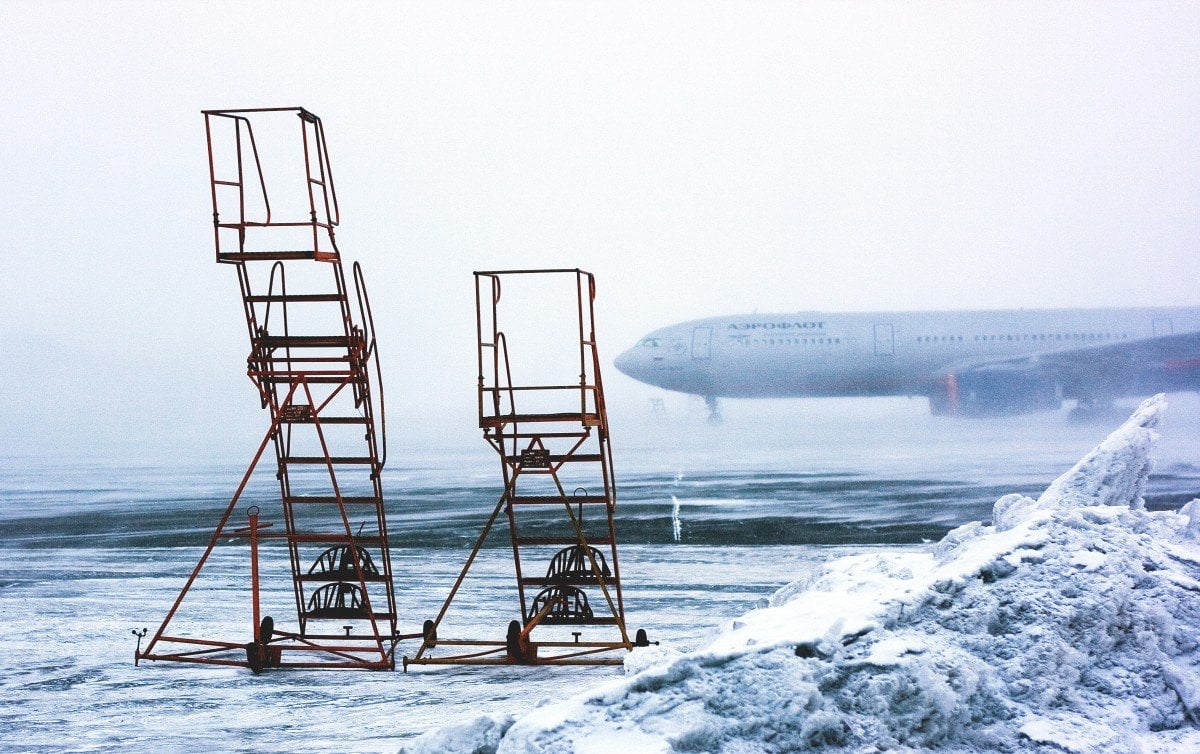 Fortunately, numerous systems and procedures have been developed to help combat the threat posed by icing. As already discussed, the ‘clean aircraft policy’ is designed to ensure that aircraft do not attempt to get airborne with any form of contamination on the critical surfaces. To acheive this, ground-based de-icing and anti-icing may be employed. De-icing is a process whereby ice which has already accumulated on a surface is removed, on the ground usually by means of hot water, or a mixture of hot water and anti-icing fluid, sprayed on to the aircraft surfaces. If the conditions are such that ice is no longer actively forming this may be sufficient -- otherwise, a further step to anti-ice the airframe will usually be required. Anti-icing, as the name suggests, is a process designed to prevent ice from forming on a surface for a certain period of time, known as the ‘holdover time’. Anti-icing fluids are generally thickened so as to enable them to ‘stick’ to the aircraft: however, this poses a problem. On the one hand, it is necessary for the anti-icing fluid to adhere to the airframe in order to perform its task of preventing any further ice from occurring, but on the other the anti-icing fluid itself may interfere with the airflow and reduce the available lift. The solution is to design fluids which are thick enough to adhere to the airframe at low speeds, but ‘shear off’, leaving a clean wing surface behind, when the aircraft accelerates for takeoff. This makes selecting the correct fluid for the aircraft type particularly important: use a fluid which is too thick for the speed of the aircraft and it will not flow off as intended during the takeoff roll! Anti-icing fluids are divided in to four types, each coloured distinctively to aid identification. Type I fluids are orange in colour and unthickened. As such, they are usually used for de-icing only. Type II and Type IV fluids, by contrast are much thicker formulations -- dyed light yellow and green respectively -- designed to shear off at speeds of around 100 knots, with Type IV fluids providing longer holdover times than Type II. This leaves only Type III fluids, also yellow in colour, which are designed for use on smaller, slower aircraft. The holdover time is dependent upon the type of fluid applied and the nature of the conditions: in mildly frosty conditions, an application of 100% Type IV fluid may provided a holdover time as long as twelve hours, but in freezing rain at temperatures below about -3°C the holdover time for the same fluid could be as little as ten minutes. The key is that the aircraft must be airborne before the holdover time expires, otherwise a further application of de-icing fluid is required, with the associated delays. Whilst we are still waiting for a full-featured ground de-icing representation, GSX provides de-icing at the stand (though not at remote de-icing pads as yet). After selecting a fluid type and mix, you can then calculate your holdover time using tables provided by the FAA or Transport Canada. Once airborne, aircraft certified for flight in to known icing conditions are normally equipped with a form of de- or anti-icing system. Such systems can range from pneumatic de-icing boots -- simple ridged rubber strips installed along the leading edge of the wing which are inflated using bleed air from the engines and mechanically break ice which has already formed off -- through to thermal anti-icing systems, typically pneumatically operated using hot bleed air tapped from the engines, but in some cases electrically powered. Some aircraft are equipped with ‘weeping wing’ systems whereby de-icing fluid stored in a tank on board the aircraft is distributed over the surfaces to be protected. It is important to know what type of system is installed on your aircraft and how it is designed to be operated. For example, best practice usually dictates that, when a de-icing boot system is in use, ice should be allowed to build up to a certain extent before operating the boots to remove it. Excessive operation of the boots before a significant amount of ice has built up can lead to a phenomenon called ‘ice bridging’ where a thin, flexible layer of ice builds up in a half-cylinder shape over the boots: when the boots retract, this ice hardens, remaining just out of reach of the next inflation cycle of the boots! Thermal pneumatic systems, on the other hand, are normally designed to be operated as anti-icing systems -- that is to say, they should be activated just prior to entering icing conditions in order to prevent any ice from building up in the first place. As such systems typically draw their hot air from the engines, however, operation can lead to slightly increased fuel burn and in many cases a slightly higher than usual engine idling speed is required to maintain sufficient bleed pressure. This in turn has an impact on descent planning -- the descent will be shallower and take more time and distance -- as well as takeoff performance (the additional bleed demand reduces the maximum amount of thrust that can be developed, reducing the maximum possible takeoff weight). Another issue is that generally only the leading edges of wings and engine nacelles are heated, as these are the areas most susceptible to ice build-up. However, if the anti-icing system is activated too late, not up to temperature or simply not designed to fully evaporate any moisture on the surface, there is a danger that any melted ice will run back from the leading edge in the airflow and re-freeze on the unprotected surfaces -- so-called ‘runback ice’. On many aircraft types, nacelle anti-ice is operated as a true anti-icing system -- that is to say, that it is switched on as a precautionary measure any time icing conditions are encountered in order to prevent the build-up of ice. Thermal-pneumatic wing anti-icing systems in particular, however, require a great deal of bleed air, sucking power from the engines and increasing fuel burn. For this reason, wing anti-ice is more commonly operated as a de-icer to remove ice which has already built up. There may also be limitations on the effectiveness of wing anti-ice when leading edge devices are in use. This is the case on the Boeing 747, for example. As discussed in the previous article, airframe icing is caused by supercooled liquid water droplets freezing on contact with the airframe. In general, we can assume that icing conditions exist when the outside air temperature is below +10C and visible moisture in the form of cloud, mist or fog with a visibility below 1500m, precipitation or standing water on aprons, taxiways or runways. In such conditions use of anti- or de-icing systems should be considered and some manufacturers may mandate periodic engine run-ups on the ground to shed ice from fan blades prior to takeoff. Of particular concern is the pitot/static system; clearly, any blockage of pitot probes or static vents as a result of ice build-up represents a significant threat to flight safety; depending on the exact nature of the blockage and the system or systems affected, a wide range of instruments could become unreliable, including the airspeed indicator, altimeter and vertical speed indicator. It is of note that the default ‘pitot icing’ effect modelled in Flight Simulator, where the airspeed drops to zero when pitot icing occurs, is potentially rather unrealistic. In real life, the response of the ASI to a pitot blockage depends on precisely where the blockage occurs: - If both the pitot head and drain holes are blocked and the pressure already within the pitot trapped, the airspeed indicator will initially be ‘locked’ in place. As the aircraft climbs or decends, the ASI will then begin to act like an altimeter: i.e. as the aircraft climbs the airspeed will appear to increase, and as the aircraft descends the airspeed will appear to decrease - If the pitot head only is blocked but the drain holes remain clear, no pressure will remain in the pitot system and the ASI will read zero A blockage of the static source will affect the altimeter and VSI as well as the ASI. If the static port is blocked: - During a climb the ASI will over-read and during a descent the ASI will under-read - The altimeter will be frozen at the height at which the blockage occurred - The VSI needle will return to and lock at zero Static source blockages are relatively well-represented in the default FS failure system. Because of the wide-ranging and potentially deadly effects of such blockages, pitot-static probes are normally heated to prevent ice from forming. On most modern airliners the heat is automatically turned on at all times whilst the engines are running, but some older designs and less sophisticated light aircraft may require manual selection of pitot heat by the pilot. With weather engines becoming ever more sophisticated in their ability to replicate the dangers of various meteorological phenomena, as well as exciting developments in the field of add-on aircraft development, it is likely that we will see much more realistic icing models within the simulator sooner rather than later. Hopefully when that day comes some of the tips within these two articles will help you stay out of trouble!
 -
 By Simon Kelsey Contributing Editor For those on the ground, the recent cold snap here in the UK meant major disruption with roads, railways and offices grinding to a halt. For any snowed-in simmers, though, it provided a veritable feast of challenging conditions. With temperatures plummeting below freezing, blustery winds, snow, freezing rain and poor visibility, cold weather operations provide a unique challenge to aircraft operation. With icing effects in the spotlight for various MSFS add-on developers at present, in this series we’ll take a look at how to fly safely and realistically in freezing temperatures. We’ll start this week by looking at icing. Icing Any amount of ice build-up on an aircraft - and particularly on the wings and tail - poses a threat. Not only does ice add weight to the airframe, even a thin layer of ice can spoil the precisely-manufactured shape of the wing, destroying the smooth airflow over the surface and, by extension, destroying lift. Even a small amount of ice can reduce lift and increase drag by as much as 40%, so it is essential -- in fact, a legal requirement -- that all contamination is removed from the wings and control surfaces before takeoff -- the so-called ‘clean aircraft policy’. Types of Icing Ice is ice, right? Not quite. There are three main types of ice which can form on an aircraft depending on the conditions and ambient temperature. The first thing to understand is that ice does not just ‘stick’ to an aircraft; indeed, any actual ice in the atmosphere presents a relatively low risk as it will largely simply bounce off. Rather, the danger comes from supercooled liquid water. In order for ice crystals to form and grow, a ‘nucleus’ is required; this is generally an impurity in the water, or a microscopic particle such as a speck of dust. However, high in the atmosphere there are few such particles around which ice can form. As such, the pure water can cool to significantly below 0°C and remain in liquid form. Shawn from Airdrie, Canada / CC BY-SA 2.0However, as soon as this supercooled liquid water comes in to contact with a solid surface -- such as a passing aircraft -- it will have found a ‘nucleus’ and thus freeze instantly. This is the cause of airframe icing: supercooled liquid water droplets freezing on impact with the aircraft structure. The type of ice formed is dependent upon the temperature of the supercooled liquid water and the size of the supercooled liquid water droplets. Danger Zones Supercooled liquid water can exist in many places in the atmosphere, but in particular convective clouds -- the fluffy ones such as Cumulus (Cu) and Cumulonimbus (Cb) -- are good generators (and Cbs pose a particular danger as, unlike other clouds, freezing rain and hail may be encountered outside the cloud, underneath the anvil -- just another very good reason to give Cbs a very wide berth!). However, that is not to say that flat stratiform clouds are completely safe: they can still contain supercooled liquid water droplets, especially if there is any turbulence associated with them. Clear Ice Clear ice is formed when relatively large supercooled liquid water droplets strike the airframe. As they impact the aircraft, the droplets spread out and, because of their large size, freeze relatively slowly. This results in a hard, glossy and transparent covering of ice over the wing. This clear ice is both heavy and, because of its transparency, difficult to see (for example, by pilots conducting a walkaround or ground staff conducting de-icing). For this reason, clear ice is often considered to be the most dangerous form of airframe icing. Clear ice is most prevalent at warmer temperatures of between 0°C and -10°C. Rime Ice Whilst clear ice is formed by relatively large supercooled liquid water droplets at relatively warmer temperatures, rime ice is formed by small droplets at colder temperatures -- typically -15°C to -20°C. Because the small droplets freeze very quickly, air is trapped within the ice structure, giving a milky appearance. Rime ice is quite brittle -- and therefore easily removed -- but its rough surface decreases aerodynamic efficiency. Mixed Ice Where both large and small supercooled liquid water droplets are encountered, mixed ice -- that is, a combination of rime and clear ice formation -- may be encountered. To make matters worse, ice or snow particles can embed themselves within the clear ice, forming highly irregular shapes on wing leading edges and significantly affecting aerodynamic performance. Mixed ice is most commonly encountered right in the middle of the temperature range: from -10°C to -15°C. The Icing Zone As we know, icing is caused by supercooled liquid water droplets impacting the airframe. However, the temperature at which water to can supercooled to is not infinitely low. In fact, at around -48.3°C, any remaining liquid water will freeze anyway through a process known as crystal homogenous nucleation. This means that the amount of supercooled liquid water in the atmosphere decreases significantly with temperature. The results of an experiment in which small water droplets were supercooled are shown in the graph below: here you can see that at temperatures below about -30°C, the number of remaining liquid water droplets is very small. Rpsear / CC BY-SA 4.0 The greatest threat to the aircraft from icing, therefore, is at relatively warmer temperatures where the larger supercooled droplets prone to forming clear ice are at their most prevalent. As a general rule, the most severe icing is rarely encountered at temperatures below about -12°C. Extrapolating this to the typical standard atmosphere model, it should become apparent that in general, the worst icing conditions can be expected below about FL100; above this level, the ambient temperature typically means the number and size of supercooled liquid water droplets are reduced. Anticipating Icing Conditions It is important to remember that two conditions are required for ice to form: Cold temperatures Moisture To put it another way -- you won’t get many ice cubes if you put an empty tray in your freezer! As such, icing conditions are typically defined as an Outside Air Temperature (OAT) below +10°C with visible moisture present. Visible moisture could be precipitation in the form of rain, sleet, snow, hail etc, it could be mist or fog with a visibility below 1500m (including in clouds!) or, on the ground, standing water on aprons and taxiways etc. For slower light aircraft, a temperature of +5°C is commonly used due to the reduced effect of ram heating on the temperature probe compared to faster jets. Taking a close look at the weather reports for your route of flight can also provide clues. Remember, what we are looking out for is the presence of supercooled liquid water in the atmosphere. Some of the METAR codes to particularly look out for are: Snow (SN) Snow pellets (GS) Hail (GR) Ice Pellets (PL) Freezing Rain (FZRA) Freezing Drizzle (FZDZ) Freezing Fog (FZFG) Snow (SN) Oddly enough, snow is probably the least of our worries when it comes to identifying dangerous icing conditions. Because snow is formed of ice crystals, the implication is that there is probably not that much supercooled liquid water aloft: it has already frozen. The likelihood of icing at lower levels, therefore, is actually reduced somewhat (though it cannot be assumed there is no supercooled liquid water aloft). Snow brings more problems on the ground, and of course any contamination must be removed. Snow Pellets (GS) Snow pellets are formed when snowflakes become heavily rimed. This typically occurs when snowflakes fall through a layer of supercooled liquid water; the implication, therefore, is that a significant amount of supercooled liquid water exists aloft and therefore this should grab our attention! Hail (GR) and Ice Pellets (PL) Hail and ice pellets are both formed in the same way; the main difference being size (ice pellets, or sleet, is generally formed of frozen raindrops or snowflakes which have melted and refrozen whereas hail is typically of 5mm diameter or more. Both imply that a layer of freezing rain or drizzle exists at some level aloft; often beneath a temperature inversion. As we will discuss momentarily, freezing rain and drizzle implies a significant icing threat. Freezing Rain (FZRA) and Freezing Drizzle (FZDZ) Spotting FZRA or FZDZ in a METAR should set alarm bells ringing. By definition, both tell us that a layer of freezing rain or drizzle exists from the surface to some level aloft. So what is freezing rain? Put simply, it is supercooled rain: droplets of supercooled liquid water which will freeze instantly as soon as they hit any solid object (like an aeroplane!). The implication is that dangerous icing conditions exist aloft: the rate of accretion of ice is dependent upon the size and number of supercooled liquid water droplets, and in freezing rain there is an abundance of large droplets. Icing accretion rates can be extreme: beyond the capability of any anti-icing system, and the best defence against freezing rain is, rather like a thunderstorm, to stay away from it! Freezing Fog (FZFG) Freezing fog, as the name implies, is fog comprised of supercooled liquid water droplets. Whilst this does imply an icing threat, fog by its very definition is of relatively low density and the droplets are very small. As such, freezing fog will generally only leave a thin film of rime ice on the airframe; however, jet engines suck in extremely large volumes of air over short periods of time and on some aircraft types there can be threat of fan blade icing in freezing fog. Ice shedding procedures usually involve period engine run-ups to remove any ice that has accumulated. So, now we know what to look for when it comes to icing conditions: in next week’s article, we’ll look at some of the systems and procedures available to defeat the icing problem.
 -
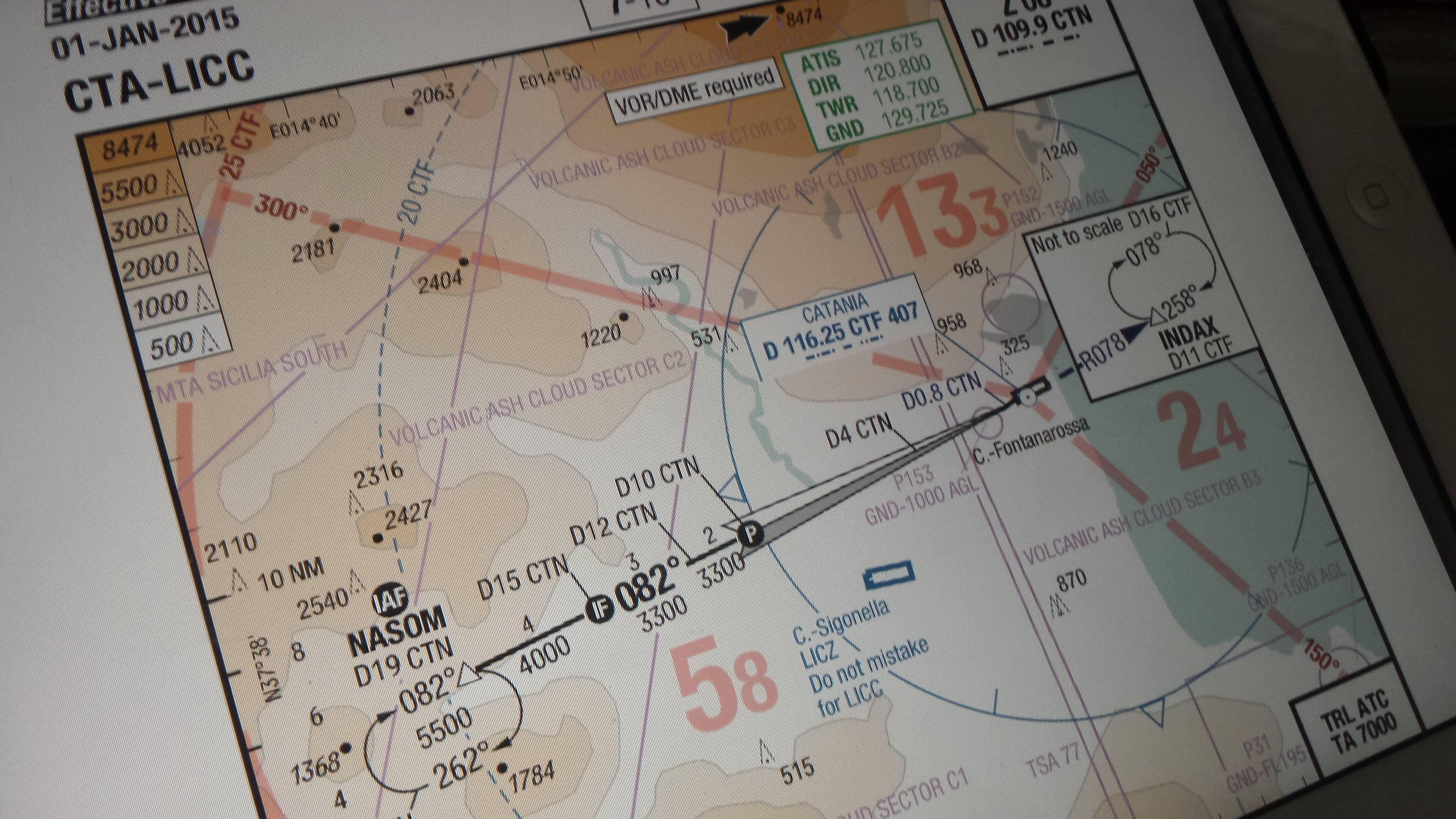 By Simon Kelsey Contributing Editor How long is eight seconds? Count it out and it doesn’t seem long at all. A Microsoft study recently suggested that the average attention span of a modern human is eight seconds; down from twelve seventeen years ago. It’s probably taken you about eight seconds to read these two paragraphs. Eight seconds is also roughly the amount of time it takes a high-bypass jet engine to spool up from idle to full thrust. Mount Etna is the largest active volcano in Europe with a summit elevation over 10,000ft One of the hazards of having a fianceé who works in a school is that those long summer holidays have a severely detrimental effect on the amount of simming time available. So when Mrs announced that she was going in to work for a couple of days to help with a summer school class, it seemed like a good opportunity to give the FSLabs A320 a run out. I’d selected a nice trip of about three hours from London Gatwick down to Catania on the island of Sicily. Sitting in the shadow of Mount Etna, the airport has a 2,400 metre runway and fairly good facilities, though only runway 08 is equipped with an ILS. This isn’t too much of an issue, however, given that in common with many coastal locations an easterly sea breeze prevails during the day. There’s also some excellent freeware scenery by Antonio Baeli in the Avsim library, which I’d downloaded and installed. Etna can cause some 'interesting' wind effects!Although Catania is surrounded by high ground on three sides, it is Mount Etna that dominates the landscape. The largest active volcano in Europe, Etna rises to over 10,000 feet just fifteen miles or so north of the airfield. As one might imagine, it has a significant effect on operations at Catania: apart from the turbulence and windshear that can be generated by a northerly wind ‘splitting’ around the peak, there are also contingency procedures in place should an eruption leave volcanic ash hanging in the atmosphere. At around 500 feet on the approach I became aware that something didn’t feel quite right. I’d drifted about half a dot low on the ILS glideslope; instinctively I squeezed on a little back stick to raise the nose slightly, placing the pitch symbol on the ADI just slightly above the 2.5 degree line. Glancing outside, I felt confused: the runway looked to be in about the right place, but the PAPI lights were indicating three white - slightly high - whilst the ILS glideslope was still showing fractionally low. Something wasn’t quite right: but what was it? Still, I was visual in severe CAVOK with the wind straight down the runway. Drifting slightly right of centreline: a little nudge of the sidestick brought things back nicely. Still a bit high: nudge forward, lower the nose just below the 2.5 degree line. Still a slight nagging doubt. A glance inside: now the glideslope shows close to three quarters of a dot low. But the runway’s just there, and the PAPIs are still showing high… FIFTY! Approach briefing notes for Catania The radio altimeter callout startled me. I was barely over the runway, the displaced threshold markings still visible over the glareshield, and now the jet was shouting THIRTY at me. I knew that somehow I’d got really low, but in the moment I couldn’t quite work out how. Suddenly aware that the ground was rushing up at me very quickly indeed, I eased back on the stick, conscious not to over-rotate and start floating down the shorter-than-average runway-- TWENTY-TEN-BOOM! A great, juddering explosion of noise seemed to fill the room. The sixty-tonne jet literally leapt back in to the air, the main gear oleos flexing and extending like the legs of an Olympic vaulter. I knew I had to keep the pitch under control to avoid a tailstrike. Do not allow the pitch attitude to increase, particularly following a firm touchdown with a high pitch rate, is what the manual says. The jet, so eager to meet the surface just a few moments ago, had suddenly developed ground-shyness: hanging in the air at what felt like a few tantalising inches above the tarmac whilst the centreline stripes disappeared below the nose in a blur. Almost subconsciously I dipped the left wing slightly, stretching desperately for the runway. As the touchdown zone markings disappeared out of sight, I did what I should have done far earlier: throw it away. I slammed the thrust levers all the way forward. And waited. Everything seemed very quiet. It takes longer than you might think for an IAE V2500 engine to spool up from idle!I was conscious of the airspeed hovering a few uncomfortable knots above the amber band. And still the thrust instruments remained rooted to the idle position. How long is eight seconds? When you’re gobbling up 72 metres of runway every second, it feels like a very long time indeed. Eventually the EPR dials started to flicker in to life. Slowly at first, then with gathering pace, the noise building from soft, almost eerie whine to trademark IAE buzz as the aeroplane finally started to claw itself back in to the hot, thin Sicilian air. With hindsight, I should have gone around from the first approach much earlier. It’s often said that every approach is to a go-around -- if you can land instead, then great. Or to put it another way - ‘if there’s doubt, there’s no doubt’. I knew something wasn’t quite right, but initially I couldn’t quite put my finger on it. Generally speaking our instincts are good: if we’re not comfortable, it’s always easier and safer to throw it away, get up to a safe height and work out what the problem is there rather than try and do so in the late stages of an approach! Items for consideration during an approach briefingAnother point which was thrown in to focus was the importance of building a mental model of the approach in advance. This is why airline pilots brief before every takeoff and landing: to ensure that each crew member knows what the plan is and what to expect. I knew what I expected the relationship between the PAPIs and the ILS glideslope to be on a normal landing: I hadn’t prepared for the difference on this landing. It also drove home how quickly one can lose situational awareness -- ‘the big picture’ -- when distracted. Instead of focusing on what was most important during the landing -- the runway and the touchdown zone -- I was instead focusing on the discrepancy between the PAPIs and the electronic glideslope. The normal go-around actions are well-rehearsed: I will call ‘go around’, push the thrust levers to TOGA. Check that thrust increases and is sufficient for the go-around. Retract one stage of flap, rotate towards fifteen degrees nose up, follow the SRS. Positive climb, gear up. Above 100 feet select a roll mode, and verify the missed approach route is being tracked. Except that this sequence will not quite work for a so-called ‘baulked landing’, especially the ‘rotate to towards fifteen degrees and follow the SRS’ bit, which at best risks scraping the tail and at worst could lead to the speed getting dangerously low whilst waiting for those engines to spool up. Instead, a go-around after touchdown requires the pitch attitude to be held steady and the gear and flaps left alone until well established in the go-around. The manuals also caution that you will get a takeoff configuration warning if you select TOGA whilst on the ground with full flap -- a noisy distraction right at the moment you least need it! I was surprised how powerful the urge to rotate up in to the flight directors was, especially with the runway rapidly disappearing, despite the initial lack of thrust and airspeed. At least the Airbus allows quick, instinctive and unconditional selection of go-around thrust and modes: just slam the thrust levers full forward, unlike the Boeing design whereby the TO/GA switches are, for good reason, inhibited on the ground after landing (and at very low heights, as at least one real-world airline crew (and many PMDG 747v3 owners) have discovered to to their cost). Needless to say, baulked landing procedures will be high up on my list of things to practice in future! With a go-around generally remaining an option on jet aircraft all the way up to thrust reverser deployment, it is worth trying out in your aircraft of choice, thinking about how you will get around the various problems thrown up by a go-around at very low altitude or after touchdown. Spoilers, autobrakes and takeoff configuration warnings may all in some combination have to be overcome: do you know what you would do?
 -
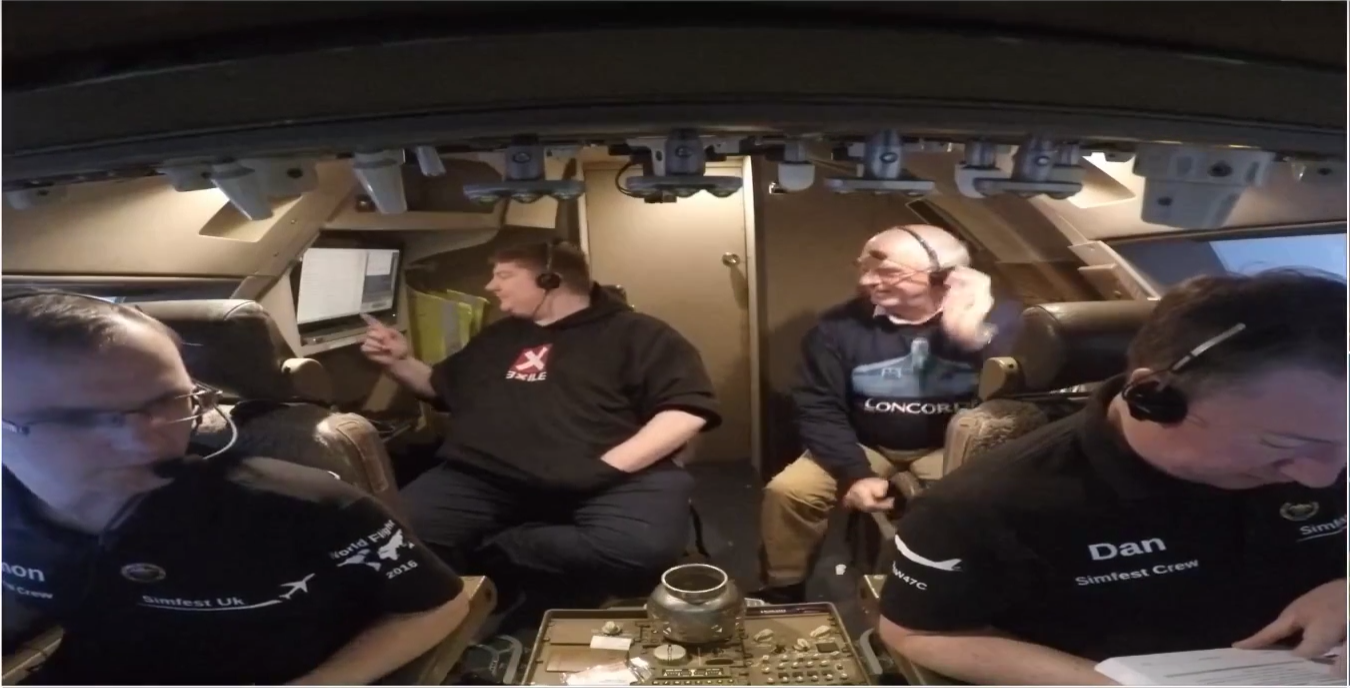 By Simon Kelsey Contributing Editor Whoop whoop whoop. I frowned as the yellow Master Caution lights blazed in to action on the panel in front of me, a string of warning messages appearing on the Boeing 747-400’s central display screen. We were on a late downwind for runway 02L at Singapore’s Changi Airport. Outside the Perspex flight deck windows sunset was fast approaching, the temperature nudging thirty degrees Celsius in thick, sticky tropical air, but beyond the garage that housed the full-scale 747 flight deck in which we were sitting it was about half past nine on a crisp November morning with a light frost on the grass. Both myself and Dan, in the left-hand seat for this leg, had been up most of the night putting in stints in various crew positions as Worldflight 2016 gradually wended its way around the globe. I was flying the approach for Dan’s landing, standard practice at British Airways. The VATSIM Singapore controller -- his voice crackling in to our headsets from halfway across the globe -- had just given us a turn on to base leg, and I’d asked for flap 10, which was where the problems started. ‘Flaps Drive,’ read Dan off the screen, already reaching for the Quick Reference Handbook (QRH) that lives in a slot in the flight deck just underneath the side window, so that it is immediately available in any situation. The QRH is a thick, spiral-bound booklet which contains details of every fault and warning message the aeroplane is capable of generating, each with a checklist to be completed. ‘OK, my radios - if you could do the Flaps Drive QRH please.’ Dan started leafing through the QRH. The first rule in any non-normal situation is to fly the aeroplane: as Pilot Flying that was my job first and foremost, so I had a quick scan of the instruments, making sure that the autopilot was still engaged, everything was stable and we were still going in the right direction. Once I was satisfied that the flight path was safe, my thoughts turned to how we would manage the problem. We can all think of times when we’ve made poor decisions in life, perhaps because we were rushed, under pressure or simply didn’t take proper account of all the details. In the flight deck, however, rushed or ill-thought-through decisions are simply not an option. In an era in which almost 80% of accidents can be traced back to human error, poor judgement and poor decision making consistently rank in the top five causes of fatal airline accidents. Commercial pilots are trained to use ‘decision-making models’. These are frameworks, acronyms such as ‘PIOSEE’, ‘NMATE’ or ‘GRADE’ to name but a few which you may already be familiar with, designed to ensure that decisions are well-considered and properly informed. British Airways uses a system called ‘DODAR’, which stands for Diagnosis - Options - Decision - Act (or Assign) - Review. Commonly a ‘T’ (for ‘time’) is added as the first item, to give ‘T-DODAR’. Time is considered first, because the options available are often directly dependent on the level of urgency. Outside of a fire or a medical emergency, there are very few situations where it is not better to either take or make more time to ensure the correct decisions are taken. In the air, fuel is time. I tell my students to stop thinking about fuel in terms of volume or mass, and instead start thinking about it in terms of time. We had about twelve tonnes of fuel on board -- in a 747-400, that gives you about forty-five minutes airborne before you start eating in to your final reserve. The Flaps Drive non-normal checklist is a long one, running to several pages in the QRH. I didn’t want us to have to rush through the checklist whilst barrelling down the approach -- and, even worse, Dan’s capacity to monitor my flying would be severely diminished if he had his head buried in a book. After a brief fuel check, we agreed that we should make ourselves some time to deal with the flap problem by going around and entering a hold. Diagnosis involves finding out what is wrong and what might be causing it. Whilst modern aircraft are generally quite good at telling you when they are poorly, it is vital to cross-check any alerts to ensure that you really are dealing with the right problem. Once the problem has been diagnosed, you can then consider your options. In our case, having decided to make some time to deal with the problem by going around and taking up the hold, we now needed to decide whether to attempt another approach at Changi or divert elsewhere. The other question was one of weight: had we had more fuel on board we might have considered holding or dumping fuel to further reduce our landing weight and therefore our approach speed. Both of these were fairly easy decisions to make. Changi was by far the most suitable airport for our situation, with three long runways, full ATC, plenty of facilities and perfect weather conditions. Weight would not be an issue either -- by the time we’d been round the hold a couple of times and made a second approach we’d be getting towards the point at which a diversion would be very tight anyway. Once the decision has been made, the next job is to act or assign tasks. In our case, we decided that I would carry on flying the aeroplane and speaking on the radio, whilst Dan worked through the checklist. Once the procedure was complete, we would revert to our normal roles, and finally Dan would take over at 1,000 feet as usual to complete the landing. The final step is review. The review is very important, and it is a continuous process. The plan must constantly be updated as the situation changes and new information becomes available -- and this can be very fluid. Just as we thought we had everything just about dealt with and under control, a soft ping signalled a call from the cabin. A passenger was unwell, said the voice from ‘down the back’. A suspected heart attack. Of course, that added a new dimension to our hitherto calm and steady operation. Up until now, we’d essentially had all the time we wanted. This latest news changed that - now we needed to get on the ground without delay, yet still without rushing and taking unnecessary risks. Fortunately we had already completed the checklist for the flap problem, so after a brief discussion we advised Singapore ATC we were now ready to make an approach and that we had a medical emergency on board. Now pointed in the right direction, we quickly reviewed the situation: with reduced flap not only would our final approach speed be significantly higher than normal, the nose attitude would also be higher than normal, giving an unusual perspective. The aircraft would likely feel more sensitive in the flare, we would have a higher than usual rate of descent on final approach and we would need a higher autobrake setting and full reverse thrust to keep both landing distance and brake temperatures as reasonable as possible. The next question was how fast we should fly on downwind. Up until this point we’d left the speed where it had been when the failure first occurred - about 190 knots. Now, though, there was an imperative to shave off as much time from the approach as possible. With hindsight, we probably could have reasonably flown up to the Flap 10 placard speed of 240 knots. However, at the time we were both concerned that we didn’t want to place any more stress on the already jammed flaps than necessary, and so restricted our speed to 220 knots. Every flight is a sequence of decisions. Some are routine, some critical, some easily reconsidered, others irreversible. Of course, in some cases the use of a decision-making model is impractical -- one commonly-quoted example is that of QF32, where an uncontained engine failure resulted in such an overwhelming cascade of failures that it was impossible to methodically feed each and every one in to a DODAR-style framework. Likewise, some emergencies are so time-critical that a conscious optimised decision-making process is simply not viable: take, for example, flight BA38 and the decision of Captain Peter Burkill to retract a stage of flap in order to extend the aircraft’s glide just enough to avoid crashing in to houses just before the airfield boundary. In this instance, the decision-making model could be boiled down to a binary choice -- quite simply, ‘will it work?’ -- based on thousands of hours of experience and training, with no opportunity for discussion or collaboration. Such is the role -- and ultimate responsibility -- of the airline captain! There is plenty of opportunity to practice and improve your decision-making skills on every flight, but with the capability of modern add-ons to accurately simulate a wide variety of non-normal situations and generate ‘service-based’ failures, there is more scope than ever to put your thinking skills to the test (though do remember to take rules around declaring an emergency in to account if you are on a network like VATSIM or IVAO). As for the conclusion to our story? The VATSIM controllers at Singapore vectored us neatly round to the ILS, Dan took over as we descended through 1,000 feet and made a perfect landing despite a final approach speed nearly 30 knots faster than usual. Although the entire scenario had played out in a simulation and we had never left the ground for real, I think we were both fairly relieved when the engines spooled down at the gate!
 -
 By Simon Kelsey Contributing Editor You’ve arrived at the gate, the engines have spooled down, you’ve completed the shutdown checklist and all your virtual passengers are headed down the jet bridge. Hours noted in your logbook, perhaps, or virtual airline PIREP filed. Job done, right? Of course, in our simulated world that can absolutely be the case, and there’s nothing wrong with that: after all, we’re doing this as a hobby and if all you want to do is shut down the PC and move on to something else, that’s fine. The virtual airline I belong to had a conference a couple of years ago at which one of our members – a retired Boeing 747 captain – gave a talk about his career. “You are all pilots,” he said, “because whether you do it for real or not, you all think like pilots.” And I think he was right: perhaps one of the aspects of this hobby which is so addictive is the fact that there’s always something new to learn, no matter how long you’ve been at it. And so we keep coming back, and we keep seeking out more complex models, more faithful representations of aircraft and their quirks, more realistic weather simulations, more detailed and immersive scenery packages – because those of us who have been at this for any length of time have likely come to the realisation that there is no such thing as the ‘perfect flight’. There’s always something which could be bettered – that switch we forgot to actuate at just the right moment, the slightly bumpy landing, the non-precision approach not quite nailed, the continuous descent from cruise not quite achieved without using just a touch of speedbrake or a squeeze of thrust somewhere – the list is endless. And, of course, because we have the mindset of the pilot – an insatiable thirst for greater knowledge and a desire for ever-greater mastery of the art and science that is aviation – we have to keep going back to try again in an effort to improve our performance. Self-critique – the ability to review a flight, identify the good bits, the bad bits and the downright ugly bits and work out how to replicate what we did well and fix what we did badly – is a valuable skill in the real flight deck. But it is perhaps even more essential to the sim pilot, who is unlikely to have the benefit of advice from an instructor or a senior colleague sitting next to them. In the sim world, it is largely up to us to teach ourselves by trial and error. In real life, many airlines incorporate a post-flight review, where the crew will discuss the flight they have just completed, as standard practice. The same principle may also be applied to our simulated flights as we strive to further increase our knowledge and proficiency. The first step is to identify what happened and, most importantly, why? Of course, the objective here is to pick out key events – both good and bad – and establish their root causes. Next, for each event determine – was the outcome positive or negative? If it was positive – what did you do? How could you repeat that performance next time? If negative – how could it be avoided? It is important at this point to stress that it is just as vital to understand why something worked well as it is to know why something else went badly. After all, if you don’t know how you managed to achieve success, how will you be able to replicate that success in the future? Other points for consideration could include the impact an event may have had on safety margins, or, for those simulating airline flights – would there have been any commercial impact? Did you know and follow the correct procedures as per the flying manuals and company policies throughout? If not, why not? You could, perhaps, make a note to look up the details in the appropriate documentation. Finally, consider what you have learned as a result of the flight, and how you might put these points in to action on your next flight. Aviation has a long history of open dialogue. Many flying magazines have an “ILAFFT” – “I Learnt About Flying From That” – column where pilots are encouraged to send in their experiences and mishaps so that others may avoid falling foul of the same traps. Likewise most real airlines have some form of in-house safety reporting system, something which we’ve introduced in the sim world within my virtual airline – a form where pilots can anonymously send in experiences they might not, for whatever reason, otherwise be prepared to put their name to in the forum. Our training team are then able to add their comments before the whole thing is pulled together in to a newsletter which has proven popular and thought-provoking. The forums here at AVSIM are an excellent source of discussion and knowledge. The number of questions posed daily on all aspects of aviation – simulated or real – and “ILASFT” (I Learnt About Simming From That) type of posts demonstrates the level of passion and desire to gain and share wisdom. For whether we do it for real (be that in a Boeing 747 or a Piper Warrior), or simply soar virtual skies on electronic wings, the thing we all have in common and the drug that keeps us coming back for more is the endless pursuit of aviation greatness.
 -
At the very least you really need to fill out INIT A (departure and arrival, flight number, cruise level) select the runway for departure and arrival on the F-PLN page (no need to select a procedure), weights and V-speeds on the PERF page (can be auto-calculated) and ideally fill out the PERF APPR page (QNH/temp/wind) as this will let the aeroplane calculate the appropriate characteristic speeds for you. So if you were doing circuits at Chateauroux, for example, you would just enter LFLX/LFLX in the dep/arr fields, bung in a flight number and a cruise level of, say, 2000ft, then go to F-PLN, select the departure runway, go back to F-PLN and select the same runway for arrival. Leave the discontinuities in, then go to the PERF page, put in a flap setting and let it auto-calculate the V speeds and flex temperature. Finally you can page across to the PERF APPR page and enter the current QNH, temperature and surface wind. Looks a lot written down but in reality only really takes a few seconds!
-
As Dan says, the PMDG 777 is the -200LR. A very, very different beast to the straight -200, which appears to be what the Topcat profile is for. Edit: just to add, for context: the straight -200s have an MTOW over 100t less than the LR and about 4,500nm less range.
-
As Kyle says, I very much doubt that your problems have anything to do with the temperature or Activesky. Let's sanity check that for a moment -- 35C is a fairly typical daytime temperature in Florida (and indeed might even be considered fairly mild in some places). At a lapse rate of around 2C per 1000ft, an OAT of 12C at 7000ft is actually quite cool if the temperature on the ground is 35C. Aeroplanes take off and climb to cruising levels quite comfortably every day from airports where the temperature is 35+C. A TAT of +35C at FL350 would be a problem, but this does not appear to be the case here. Therefore, the problem probably lies elsewhere -- my first suspicion is the same as Kyle's, if your flaps are assigned to a hardware axis this is known to cause problems.
-
Of course. Mea culpa! There is no climb required at CRVET as far as I can see. You could be quite happily cruising along over SAV and CHECR at FL350 -- the only requirement is to start a descent to cross CRVET between FL240 and FL290. I would guess that there is an alternative STAR for traffic cruising below FL240, but I stand to be corrected.
-
I don't use the FAA charts routinely, but assuming the conventions are similar to the presentation on the Lido charts I am more familiar with: FL190 and FL180 (etc) noted next to the route line are not altitude restrictions (as such), they are MEAs (Minimum Enroute Altitudes). In other words, you can't fly the segment between SAV and CHECR at any less than FL190. *1700 and *1600 are MSAs (minimum safe altitudes) for the route segments. MEA is usually driven by navigational concerns (navaid reception, airspace etc) whereas MSA is usually a terrain/obstacle issue. Normally you would be a long way above the minimum altitudes -- they are there for emergency use.
-
"Go around, flap 20." :wink:
-
Errm.... don't press all the way down on the pedals? What would happen if you stood on the brakes in your car as hard as you could at high speed? You're locking the wheels and blowing the tyres/overheating the brakes and causing the tyre fuse plugs to melt. Either way, you're not going to go anywhere fast afterwards.
-
Russia does use metres QFE below TA, but will provide QNH on request and whilst I can't speak for Flydubai, at a Big Airline QFE operations are verboten so it is normal to request and set the QNH (heights will still be given in metres QFE by the controller but the approach chart includes a metres QFE --> feet QNH conversion table). That said, it would be much easier if the Russians would come in to line with the rest of the world, and I suspect as time moves on they will move in that direction: my understanding is that the current situation (also in China with metric) is due to the fact that many older Russian-manufactured aircraft, and particularly military aircraft, are simply not equipped with altimeters calibrated in feet and so the system exists to cater for them. With more Western aircraft being operated by Russian operators, and Russian manufacturers designing aircraft for a global market, I imagine the situation will change sooner or later.
-
The pressure changes (decreases) with altitude -- this is how an altimeter works, by measuring the actual pressure and comparing it to the datum set in the window. This works because the pressure reduces at a variable with altitude, but known rate -- at sea level, 1hPa = approximately 30ft (actually about 27, but it changes with height and 30 is close enough for flight deck work and a nice round number to do mental maths with). So you can express an altitude either in terms of feet, or in terms of the ISA air pressure at that level (so, for example, the air pressure at 10,000ft is 700hPa according to the ISA and you will sometimes see weather charts that express altitude in terms of pressure (hPa) rather than units of length (feet)). Thus, a change in height of 346ft is equal to a change in pressure of 13hPa (346/27 = 12.8). This is particularly useful to a pilot who wants to set QFE on the altimeter for landing: the QFE is the QNH adjusted for the elevation of the threshold. So if the QNH is 1013hPa, setting 1000hPa (1013 - 13) will make the altimeter display height above the threshold during the approach and landing. Displaying the threshold elevation in terms of hPa on the chart does 50% of the sums for the pilot, so all they have to do is take that value and subtract it from the QNH. QFE is hardly ever used in modern commercial transport operations (FMS systems are normally designed with QNH in mind and setting QFE confuses them), but GA and the military (read: RAF) use it extensively as many of their procedures are based on height, not altitude.
-
Depends where you fly in to... there are some parts of the world where ATC just loves to keep you high (Italy, for example, is notorious for it), either because of airspace restrictions, terrain, other traffic flows or various other reasons. In other places you might get offered a big shortcut if you can make the profile work (Heathrow, for example, will occasionally offer a very direct routing perhaps from some way prior to the holding fix if it's quiet and the result is usually a high speed descent with lots of speedbrake), but it will be on the basis of mutual agreement. In the UK you will be given your track miles to touchdown at the start of vectoring to final approach so you can judge your rate of descent (ideally to achieve a continuous descent from that point, i.e. avoiding level flight all the way up to glideslope capture and beyond). Generally speaking though, as Dan says, most controllers have a reasonable idea of aircraft performance and will know more or less what is and isn't typically achievable -- bear in mind that they'll generally be working the same sector very regularly if not every day and they will know the points where pilots usually want to start down, how fast they can descend and the normal vectoring profile will have been constructed with typical performance capabilities in mind.
-
-
It was back, but it's gone back down again -- there were still some issues with the forum and schedule database, so I assume the tech team are in the process of fixing it (which may be why it's down again). I'll see if I can find out any more. Sorry guys!
-
Not using pedals, but a spare axis (throttle on my Sidewinder Pro as I am using the Saitek TQ for the thrust levers). Make sure that you are not 'processing' the axes in FSUIPC -- i.e. assign LeftBrake and RightBrake, then go to the Joystick Calibration tab and click the "Reset" button on both left and right so that it says "Axis not processed". You should then find that it works correctly, I think.
-
Just to update you -- the Tech team are on it and it should be fixed shortly.